1942 Quarter No Mint Mark: One Date, Two Markets, and Several Wrong Assumptions

A 1942 quarter no mint mark is a Philadelphia coin. That part is normal. The problem starts when people assume that every 1942 quarter without a mint mark belongs to the same market. It does not. There is a regular Philadelphia circulation strike with a mintage of 102,096,000, and there is also a 1942 Philadelphia proof with a mintage of just 21,123. Same date. Same mint. Very different market ranges.
That is why this coin still confuses. To quickly distinguish them, use a coin value checker or read the article further to know the details.
What Does “No Mint Mark” Mean on a 1942 Quarter?
On a 1942 quarter, no mint mark means Philadelphia. It does not mean error. It does not mean a special issue. It does not add value on its own. For this date, the missing mint mark is simply the normal Philadelphia format.
This is the first wrong assumption many collectors make. They see no mint mark and assume the coin is unusual. That is not the right question here. The better question is this: Is the coin a regular strike or a proof? That distinction matters far more than the absent mint mark.
A summary helps:
- No mint mark = Philadelphia
- A regular strike exists
- Proof also exists
- Value depends on format and grade, not on the missing mark alone
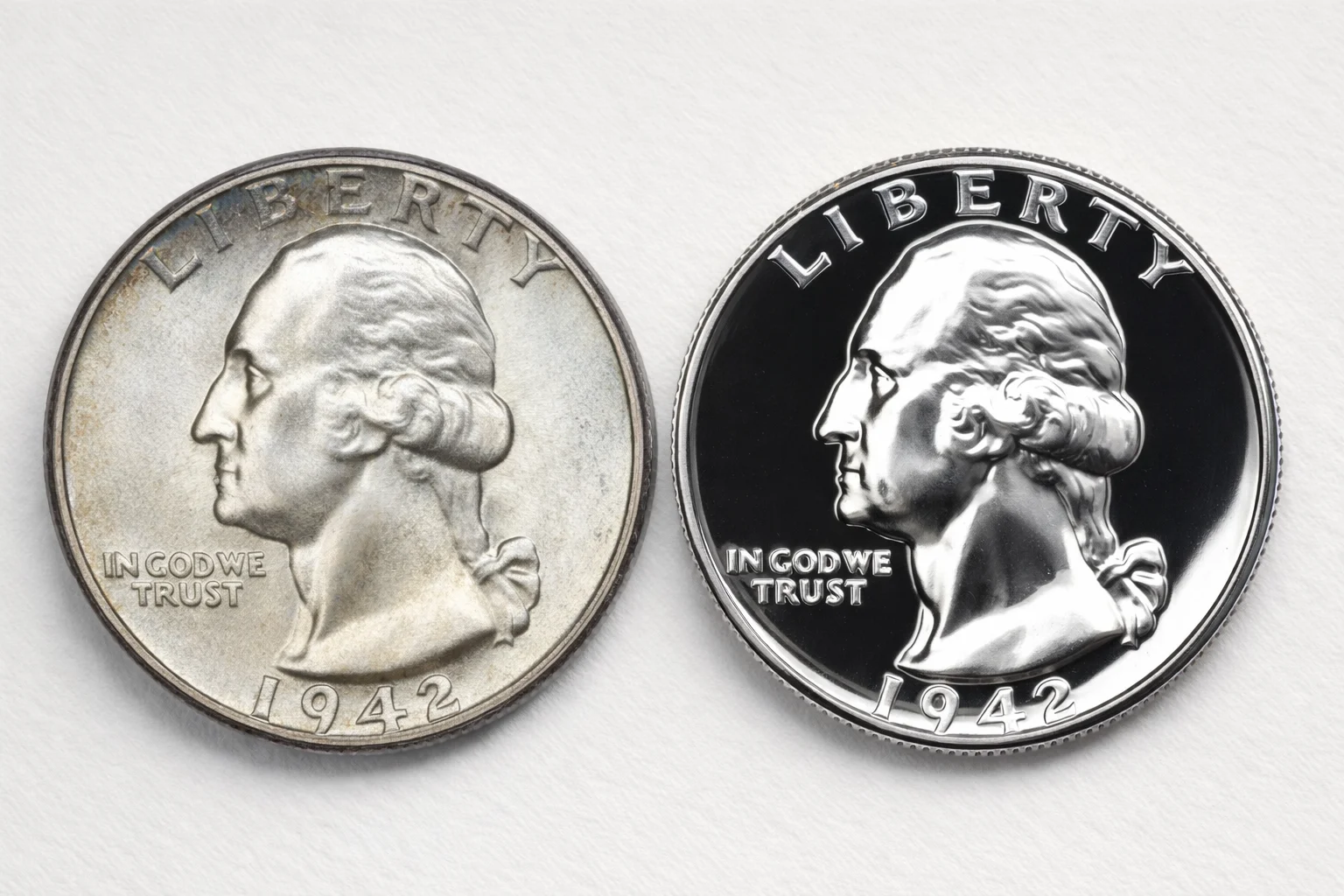
Two Coins, Not One: Regular Strike and Proof
The regular 1942 quarter without a mint mark was made for circulation. PCGS lists the mintage at 102,096,000. It is a silver Washington quarter meant for daily use, and in lower grades, it behaves like one. The proof is different from the start. PCGS lists the proof mintage at 21,123. That is a collector issue with a much smaller market and much stricter surface standards.
The table below shows why these two coins should never be priced as if they were the same thing.
| Version | Mint mark | Purpose | Mintage | What matters most |
| 1942 regular strike | None | Circulation | 102,096,000 | grade, luster, marks |
| 1942 proof | None | Collector issue | 21,123 | mirrors, hairlines, proof quality |
That split changes the whole discussion. A worn regular strike stays close to silver-quarter logic. A proof coin follows a collector market from the start. Even before grade comes into play, these are two different products.
This is also where the free coin apps earns its place. On a date that exists as both a circulation strike and a proof, the useful part is comparison. The Coin ID Scanner helps keep coin cards, saved examples, and value ranges separated, so a normal silver quarter is not priced like a proof, and a proof is not dismissed as just another common Philadelphia coin.
Basic Facts About the 1942 Quarter
Both 1942 no-mint-mark quarters share the same basic specifications. The design is by John Flanagan. The composition is 90% silver and 10% copper. Weight is 6.30 grams. Diameter is 24.30 millimeters. The edge is reeded. Those basic facts do not separate the two markets. They only establish that both coins are real silver Washington quarters from Philadelphia.
The basic specifications below apply to both the regular strike and the proof.
| Feature | 1942 Quarter |
| Coin type | Washington quarter |
| Designer | John Flanagan |
| Composition | 90% silver, 10% copper |
| Weight | 6.30 grams |
| Diameter | 24.30 mm |
| Edge | Reeded |
| Mint mark status | No mint mark on Philadelphia coins |
That is why the value discussion must move past the raw specs. Silver content matters in lower grades. After that, grade, finish, and format take over.
The Regular 1942 Quarter: Common Date, Better Story in Strong Grades
The regular 1942 Philadelphia quarter is not a scarce date in overall terms. Circulated examples are at about $14.25 to $16.75 as of March 2026. That keeps the coin in normal silver-quarter territory when it is worn and ordinary.
The interesting part begins later. The 1942 quarter is “a bit of a sleeper in Gem condition” and is scarcer in Gem than most other Washington quarters of the period. That does not make the date rare across the board. It means the better coins get stronger faster than many buyers expect.
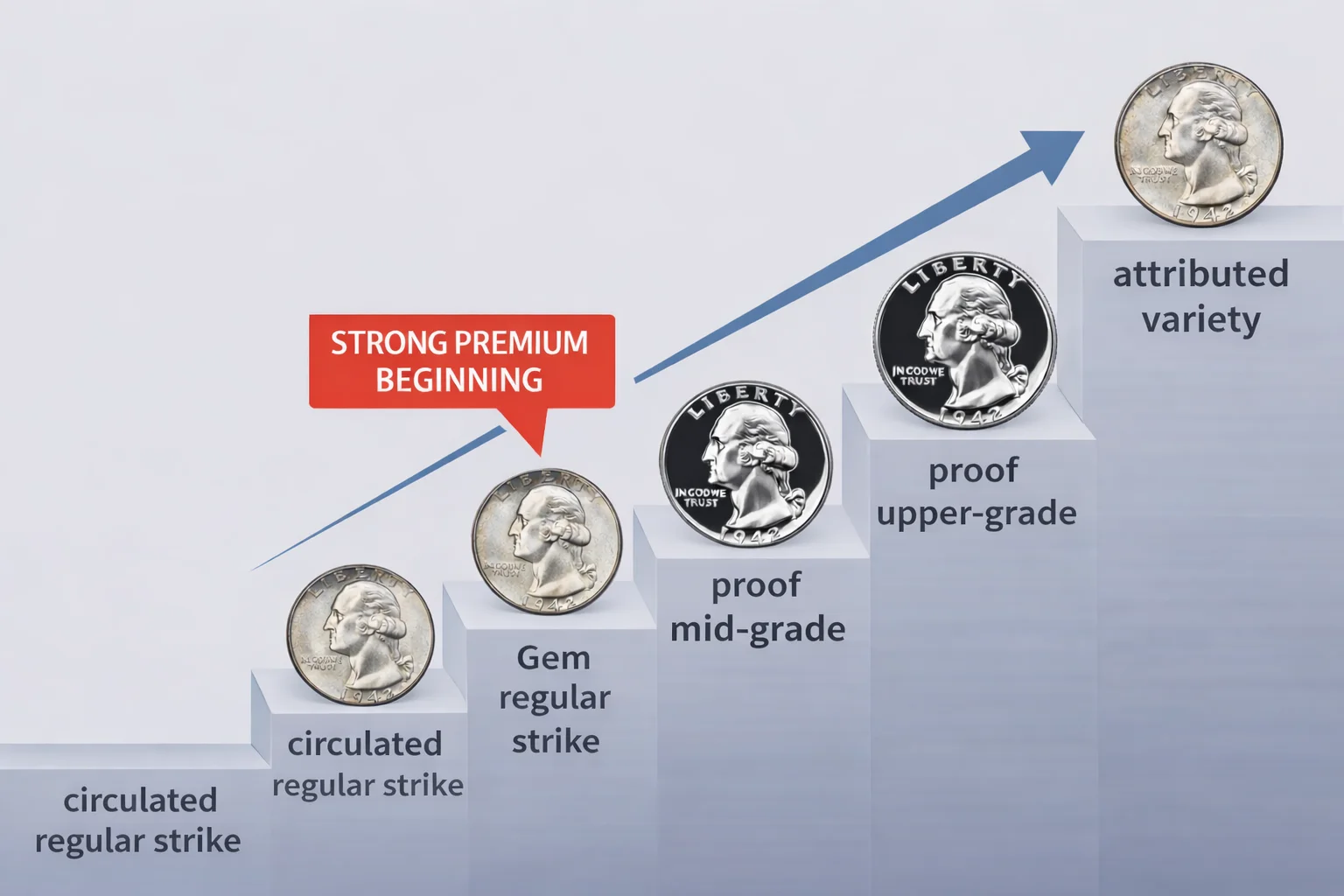
A simple progression explains the market:
- Circulated coins: mostly silver-driven
- Lower Mint State: modest premium
- Gem pieces: much more collector interest
- Top-end certified coins: auction-sensitive
The Proof 1942 Quarter: A Separate Market From the Start
The proof 1942 quarter is not just a nicer version of the same coin. It belongs to a separate market. PCGS lists the mintage at 21,123 and records an auction high of $16,800 in PR69. That alone shows the difference in market structure.
Here, the standard is different. Collectors look at mirrors, hairlines, field quality, and overall proof preservation. Only the highest proof levels in this issue are truly scarce, while PCGS population and auction data show that the jump from mid-proof to upper-proof grades is steep.
Recent auction markers show that difference clearly. PCGS auction data shows a PR67 example selling at $240 in August 2025. PR68 examples sold at $3,000 in May 2024 and $4,080 in August 2023. The date did not change. The market did, because the proof grade changed.
A short comparison helps:
- Regular strike = circulation coin
- Proof = collector coin
- Regular strike value rises with the condition
- Proof value rises with preservation and proof quality
1942 Quarter No Mint Mark Value Overview
The table below gives the clearest practical view of the date. It combines NGC guide data for circulated coins with market signals for better regular strikes and proofs.
| Version | Typical lower-range value | Where premiums begin | What moves the price |
| Regular strike, circulated | about $14.25–$16.75 | better Mint State | grade and eye appeal |
| Regular strike, Gem | far above the circulated level | upper Gem | scarcity in strong grades |
| Proof, mid-grade | collector premium, but still accessible | PR67 area | proof quality and surfaces |
| Proof, upper grade | much stronger premium | PR68 and higher | mirrors, marks, top certification |
| Varieties | separate market | recognized attribution | variety demand and grade |
The key point is simple. The no-mint-mark feature does not create the price. The format and the grade do. That is the split many buyers miss.
Several Wrong Assumptions About the 1942 No-Mint-Mark Quarter
Wrong assumption 1: No mint mark means rare
It does not. On this date, it means Philadelphia. Nothing more. A 1942 quarter without a mint mark is normal.
Wrong assumption 2: Every 1942 no-mint-mark quarter is the same coin
It is not. There is a regular strike and proof. They have the same date and the same mint, but the mintage and market structure are very different.
Wrong assumption 3: Silver explains the whole price
It does not. Silver explains the lower range for circulated regular strikes. It does not explain why a proof in PR68 can sell for thousands, or why a Gem regular strike can move far above a basic circulated coin.
Wrong assumption 4: Any odd-looking detail must be a rare error
Not on its own. Weak strike, wear, cleaning, damage, and machine effects confuse many coins. Real varieties need attribution. This date has recognized varieties, but that is a separate question from the missing mint mark.
Varieties and the Coins Worth a Closer Look
The 1942 Philadelphia quarter has more going on than many buyers expect. PCGS lists several recognized die varieties for the regular strike, including 1942 25C DDO FS-101 and DDR FS-801, FS-802, and FS-803. That gives the date another layer beyond the standard silver-quarter discussion.
These varieties do not turn every 1942 quarter into a premium coin. They do mean that a coin with real doubling should not be dismissed without a closer check. The market for attributed varieties is separate from the market for the ordinary date coin. PCGS lists a $5,875 auction record for the 1942 DDR FS-801 in MS66, which is enough to show that attribution can change the conversation completely.
The practical point is simple:
- A normal no-mint-mark quarter is common in worn grades
- A proof is a separate collector coin
- A recognized variety is a third lane with its own premium structure
FAQs
Is a 1942 quarter without a mint mark rare?
No. The missing mint mark means Philadelphia and is normal for this date.
Is every 1942 no-mint-mark quarter valuable?
No. Circulated regular strikes usually stay around normal silver-quarter levels.
Are 1942 proof quarters valuable?
Yes, but the market depends heavily on proof grade and surface quality. Recent PR67 sales were around the mid-$200 range, while PR68 examples reached into the thousands.
Does silver content make the coin expensive?
Not by itself. Silver sets the base for lower-grade regular strikes. Better grades and proofs follow stronger collector premiums.
What matters most for value?
Format first, then grade, then variety. That order explains most 1942 no-mint-mark quarters correctly.
What should a buyer check before paying more?
Check whether the coin is a regular strike or a proof. Then judge the surfaces. Then think about grade. Only after that should variety or premium claims enter the discussion.
Conclusion
The 1942 no-mint-mark quarter confuses people because the date looks simple. In reality, it creates two markets. The regular strike is common in lower grades and more interesting in strong Mint State. The proof is a collector issue with a much smaller mintage and a very different price curve. The missing mint mark explains almost nothing by itself.
That is why this date rewards a cleaner way of looking at it. First, separate the regular strike from the proof. Then judge the grade. Then check whether the coin is just a normal Philadelphia quarter or something more.